

chevron_left
-
 play_arrow
Icon Radio
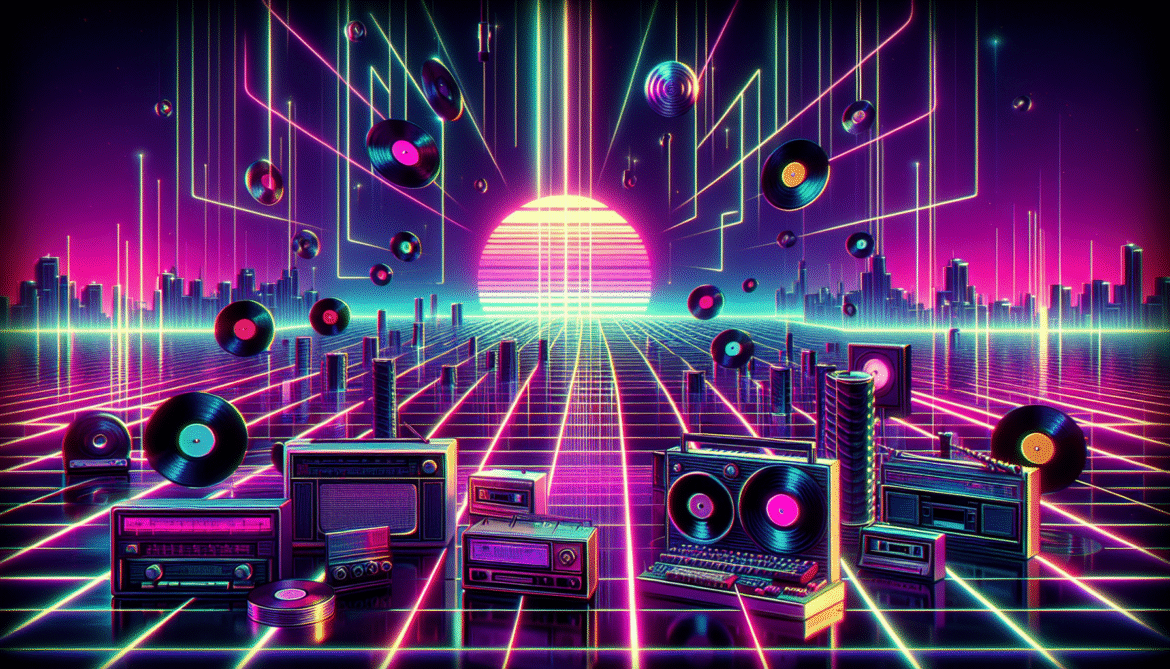
Wide-format (1920x1080) full 1980s synthwave scene. Neon grid stretches to a glowing horizon with pink, purple, and cyan skies. Floating vinyl records, retro radios, early drum machines, and synthesizers hover above the grid, radiating neon light and casting glowing reflections. Dynamic neon sound waves pulse through the air, twisting and weaving around the objects. Geometric light streaks, glowing laser lines, and retro-futuristic city silhouettes fill the background. Strong high-contrast lighting, glowing gradients, and subtle neon fog create depth and motion. Objects are stylized and exaggerated, with vibrant color blocks and reflections, minimal realism, fully cinematic synthwave aesthetic. Horizontal composition, bold neon colors, glowing horizon, retro futuristic vibe, chaotic and energetic — visualizing 1980 radio uncertainty and musical experimentation. No text, no logos, no modern elements, pure synthwave.
1980 – Radio Didn’t Know What Was Next
In radio, 1980 was a year of hesitation, improvisation, and quiet panic. A year when programmers, artists, and audiences all sensed that the ground had shifted, but no one could yet agree on where it had landed. The sounds filling the airwaves did not point in one direction. They pointed everywhere at once.
Looking back, that uncertainty is what makes 1980 so important. It was not a year defined by a single movement or dominant style. It was defined by radio trying to hold itself together while the future kept changing the rules.
The Disco Hangover
Radio entered 1980 carrying the weight of the late seventies.
Disco had ruled the charts, clubs, and airwaves with an authority few genres ever achieve. By the end of the decade, that authority had collapsed almost overnight. The backlash was swift, loud, and deeply emotional. Stations that had leaned heavily into disco scrambled to distance themselves from it, sometimes erasing it entirely from their identities.
But disco did not simply vanish. Its rhythms, production techniques, and melodic instincts lingered in pop songs that did not want to be called disco anymore. Radio found itself playing music that still moved like disco, but no longer dressed or branded itself that way.
- Advertisement -
The result was confusion. Was this music part of the old era or the new one? No one could say with confidence.
No Clear Replacement
In previous transitions, one dominant style often stepped in to fill the void. That did not happen in 1980.
Rock was splintering. Arena rock was booming and dependable, but it felt rooted in the past. Punk had already burned through its initial shock value and was evolving into something more nuanced and less confrontational. New wave was emerging, but it had not yet defined itself for mainstream audiences.
Pop sat in the middle, borrowing elements from all sides. Some songs leaned toward experimentation, others toward comfort. Radio playlists reflected that tension. One track might sound like a continuation of the seventies, the next like a message from a future no one fully understood yet.
For programmers, consistency became a challenge. For listeners, unpredictability became the norm.
Programming Without a Map
In 1980, radio did not have a clear playbook.
Formats were adjusting in real time. Decisions were often reactive rather than strategic. Songs were tested cautiously, sometimes pulled too quickly, sometimes held onto for familiarity rather than conviction. The concept of what sounded modern was in constant flux.
- Advertisement -
This created a unique listening experience. Turning on the radio in 1980 could feel disorienting in the best possible way. Genres overlapped. Moods shifted quickly. The boundaries between rock, pop, and emerging alternative sounds were porous.
What radio lacked in certainty, it made up for in discovery.
Songs That Felt Like Experiments
Many of the songs that defined 1980 sounded like trials rather than final statements.
Production was changing. Drum machines and synthesizers were beginning to appear more frequently, but they were not yet standardized. Some tracks felt sleek and futuristic. Others felt awkward, as if technology had arrived before anyone knew how to use it properly.
Vocals grew cooler and more detached in some corners, while others doubled down on emotion and intensity. Song lengths tightened. Arrangements became more economical. Excess, once celebrated, was quietly trimmed away.
Radio was effectively auditioning the future in public.
Audience Tastes Begin to Split
Another challenge for radio in 1980 was the growing fragmentation of audiences.
Listeners were no longer moving as a single mass. Tastes diversified rapidly, shaped by age, geography, and subculture. What excited one group left another completely cold. The idea of a universal hit was becoming harder to sustain.
Radio responded by narrowing some playlists and broadening others, sometimes within the same station. This balancing act was delicate and often imperfect, but it marked a significant shift in how radio related to its audience.
The seeds of specialized formats and niche programming were being planted, even if they would not fully bloom for a few more years.
The Quiet Rise of Mood
One subtle but important change in 1980 was the growing importance of mood.
Songs were no longer just about hooks and choruses. Atmosphere mattered. Texture mattered. A track could succeed not because it exploded out of the speakers, but because it created a feeling listeners wanted to stay inside.
This shift would become central to the sound of the eighties. In 1980, it was still tentative, still uneven, but unmistakably present. Radio, intentionally or not, was teaching audiences to listen differently.
Why the Uncertainty Mattered
It is easy to romanticize years with clear identities. 1980 resists that treatment.
What makes it ICONIC is not clarity, but transition. Radio was doing something rare, it was admitting uncertainty, even if unintentionally. Instead of dictating taste with absolute confidence, it was responding, adjusting, and occasionally stumbling.
That openness allowed new sounds to sneak through. It allowed experimentation to reach mass audiences. It allowed listeners to hear the future forming in real time, imperfections and all.
The Calm Before Definition
By the time the early eighties fully arrived, radio would regain its footing. Formats would solidify. Sounds would sharpen. The decade would develop a confident sonic identity that still resonates today. But that confidence was earned in 1980.
- Advertisement -
This was the year radio listened as much as it spoke. A year when the airwaves reflected uncertainty, curiosity, and possibility all at once. A year that did not know what was next, but kept broadcasting anyway. And sometimes, that is exactly how the future begins.
Similar posts
-
 Now playing
